National initiator & sponsor
Enter
Enter backs and funds the program, bringing Moldova's children a complete cycle of ecological education.
A national ecological education initiative
The children of Moldova live the full cycle — from a greenhouse and a tiny seed to a sapling and a real forest.
The Idea
Muguri Verzi is not a one-day event. It is a permanent school program, designed to last for decades: every child lives the entire life cycle of a tree and understands, with their own hands, what it means to grow a forest.
Every child puts a seed in the soil.
Saplings grow for years in the school greenhouse.
The trees reach Moldova's forests.
Where we start
For comparison, Europe's average forest cover is above 30%. That is our starting point — and the reason we plant.
About us
Muguri Verzi is delivered by Enter together with its partners, as part of the national effort to expand Moldova's forests. Enter is the initiator and sponsor that makes it possible; the partners bring forestry and educational expertise.
National initiator & sponsor
Enter backs and funds the program, bringing Moldova's children a complete cycle of ecological education.
Forestry partner
The Moldsilva agency brings forestry expertise, nurseries, and the link to the national planting campaign.
Partner
Role to be confirmed.
Partner roles and logos are being confirmed.
The program's mission
We are growing a generation that cares for nature through real action.
The Project — from seed to woodland
The program unfolds in successive phases, following nature's real rhythm and the national planting calendar.
We announce the program, prepare schools, and spark the children's curiosity.
Each school receives a greenhouse where the first seeds begin to grow.
Children tend the saplings and keep a living diary of their growth.
A drawing and collage contest among the participating pupils.
The main event, with regional and national finals and prizes from Enter.
Participants
The schools and partners growing tomorrow's forests together.
This program is theirs
They plant the acorns, water the saplings and watch them grow — from the classroom windowsill to the forest.
Being confirmed
The partnership with 100 Frontieres is being confirmed — we will announce it here once it is official.
They host mini-nurseries in their yards and make room for the forest in everyday school life.
They turn sapling care into living lessons about nature, patience and responsibility.
The state forestry agency advises on native species, land and good planting practice.
Demo data — the list fills in as schools join.
Where forests are born
Every point is a school growing its own forest. Explore the map of Moldova.
The map fills in as schools join the programme. Dots mark the locality only, never an exact address.
Chișinău
Pilot school
Bălți
Participant
Cahul
Participant
Gallery
The program's visual progress, from bare ground to living saplings.
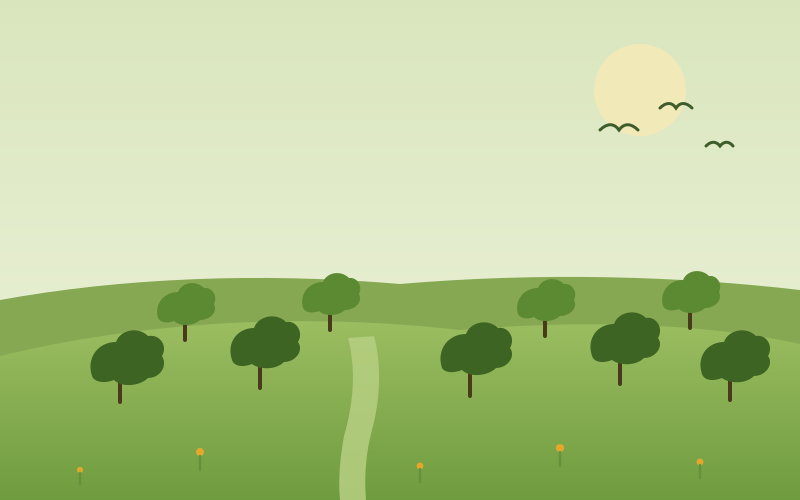
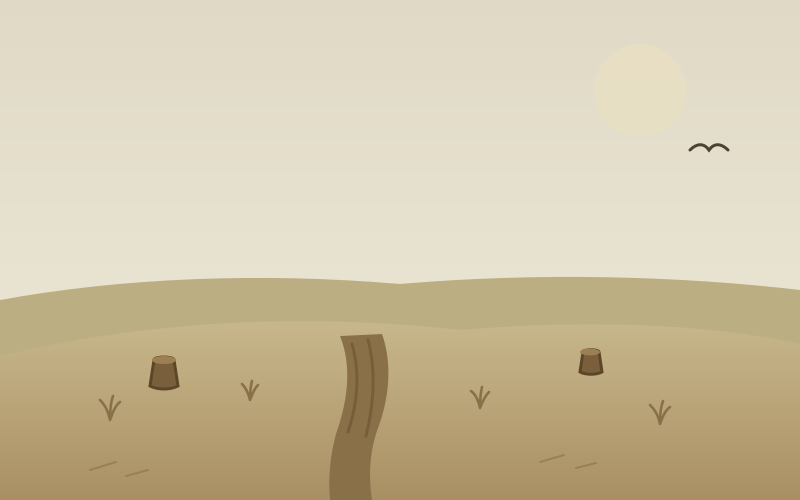
These scenes are illustrative. Real photography from the schools will replace them as each phase is completed.
Our plants
The native species we grow, with everything a young forester needs to know.
Quercus robur
Can live for over 500 years.
Quercus petraea
Prefers hills and well-drained soils.
Fraxinus excelsior
Its leaves appear late in spring.
Acer campestre
Its seeds spin down like little helicopters.
Tilia cordata
Its flowers make tea and honey.
Carpinus betulus
Its trunk has a rippling, muscular pattern.
Robinia pseudoacacia
Its flowers make one of the finest honeys.
Ulmus laevis
Its leaves have a lopsided base.
Betula pendula
One of the first trees to colonize open ground.
Populus alba
It grows fast along riverbanks.
Prunus avium
Its small fruits feed the forest birds.
Fagus sylvatica
Its young leaves are edible.
CO₂: a projection at tree maturity, not a live measurement.
Frequently asked questions
Short answers to the questions we hear most often from schools and sponsors.
Any school in Moldova can enroll as a participant, and any company can become a sponsor.
It is a permanent, multi-phase program that follows the natural growth cycle of trees across the school year.
A greenhouse, seeds and saplings, educational materials, and access to the national contest with prizes.
Native species suited to Moldova — oak, ash, linden, maple and others. See the Plants section.
Contact & enrollment
One class, one schoolyard, one row of saplings — that is how a forest starts.
Child privacy: we publish only first names, schools and localities, with parental consent. To have a photo or a name taken down, write to us through the form above — we respond and remove it.